Sunday, 23 February 2020

Essay

How well has photojournalism constructed the truth over time?

Photography is a form of art originating in the 18th century, intertwining light and real life subjects to capture what the visual eye sees. Throughout time and the change of world, including geographical, political and social changes, photography has acted as both an entertainment and news source, e.g using photography to document war but also selling and presenting as 'art' in exhibitions. The change in technology from Leica and 35 mm cameras to DLSR's has physically given photographers a wider range to use for documentation, therefore an increased chance to clearly capture a scene, and replicate the truth of said scene. However, the photographers intention behind photographing may differ, with further technical on set and post production editing settings that play with the truth of images, these settings also being more advanced and developed from the beginning of the editing period in early 1860's, not so long after Nicephore Niepce and Louis Daguerre's Daguerreotype and Heliograph photography discovery, the earliest forms of photography itself, in linkage to one of the first photojournalists, Carol Szathmari and his work within the 1850's Crimean War. These figures of photography are those who began the art-form techniques, attempting to reflect the truth of the visual eye in daily life and news situations.

The first forms of photojournalism began in 1850's, just before 'retouching' in photography began. It seems war photography was the most common form of photojournalism, in which I will explore within this essay, with distribution to widespread magazines and newspaper articles over the years.
A 20th century example is photojournalist Nan Goldin, known for her exposing portraiture photography exploring drug overdose - heroin in particular, LGBT rights and women's intimacy rights. She documented transgender communities in 1970's, experienced death by friends due to her photojournalism in LGBT during the Aids epidemic in 1980's, to photographing drug abuse in early 2000's. Her photojournalism explores subjects that were not as widely explored or spoken about, capturing these social environments with "no censor" (Abrams, Loney, 2016) A photo from her collections, 'Cookie and Millie in the Girls Bathroom at the Mud Club' is a photograph of two young women who have the 'Heroin Chic' look, sitting in a bathroom that looks to be before, during or after a party / drug use situation. The 'Heroin Chic' look was a popular fashion trend converging with photography, where models would have skinny, bone exposing facial and body features with tired under eyes and light, pale skin. (Helmore, Edward, 2019) The romanticised drug look began in consideration of the time period, when heroin had developed into middle class use instead of lower class. Goldin captured this through the shot of both girls, though the situation is negative their facial expressions seem otherwise, with a contrast of black faded film and bright red dresses / makeup. The photograph is a key example of exposing a time period with a situation that was becoming increasingly popular in society, therefore Goldins intention of using photography to document her time period.
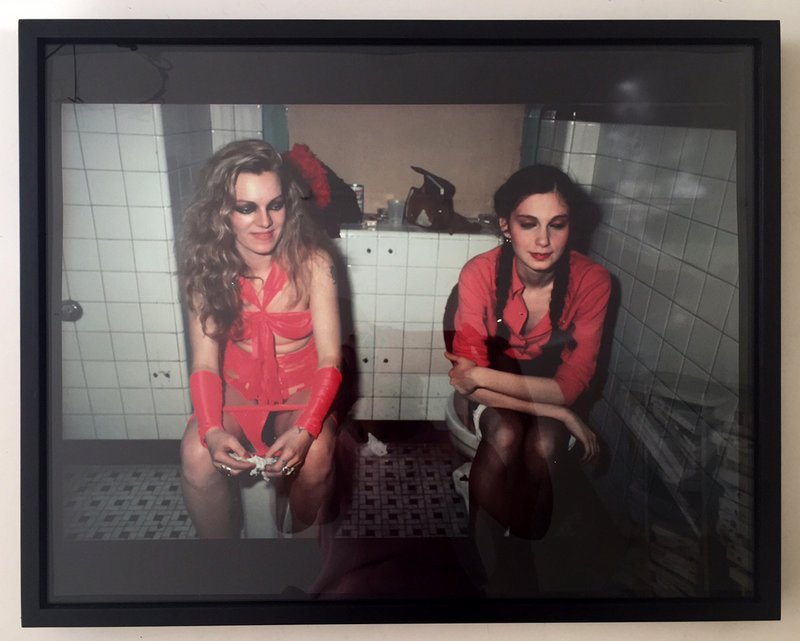
Nan Goldin, Cookie and Millie in the Girl's Bathroom at the Mud Club, NYC
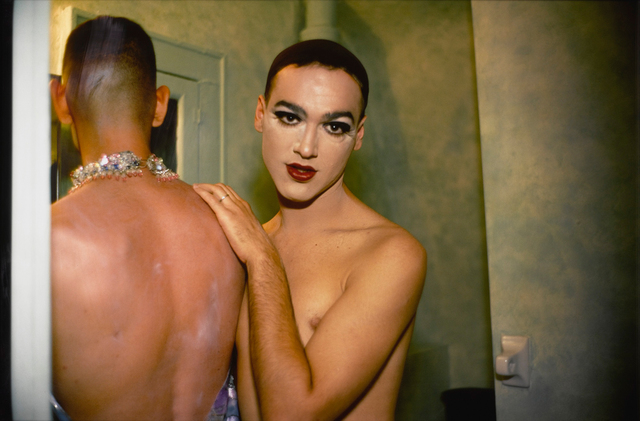
Image result for nan goldin jimmy paulette and taboo in the bathroomHer photojournalism is therefore a successful example of documenting a certain time period, exploring communities and subjects many may not know about, or be afraid to speak of at the time. "Jimmy Paulette and Taboo in the Bathroom" is a further example of this, part of her documenting transgender and LGBT lifestyles and showing these to larger American societies. The fact that some works of Goldin were seen as controversial, in my opinion, means Goldin explored the truth rightfully and exposed topics in a century that required breakthrough and information on for daily lifestyles, for topics such as LGBT to be seen as more normal, to remove the uncomfortable stigma attached to speaking on the issue, using photography as a suitable medium to do so. Her 'glamorisation' of deprived lifestyles allows a raw,  uncensored level of truth that one may need in order to fully explore the truth in society using photojournalism.

The photographer also did some journalistic work for a magazine called I-D, a young audience oriented magazine that included her drug and sex photograph collection. As a contemporary magazine, I myself have viewed a few pieces, first viewed in article for influencer Troye Sivan. If photojournalism does reflect the truth of events successfully, the distribution and where the photographs are seen also plays a key role to the audience. Nan Goldins experience with I-D was that some photographs were named as too exposing, and many of her works had to be taken down throughout exhibitions and magazines throughout the world, for being too indecent or against legislation. Though photojournalism may tell the truth, it may counteract otherwise on platforms and distribution areas, manipulated as the news or photograph spreads, or manipulated in written form, in terms of magazines and newspapers, also known as print journalism.

Photography, just like art, is a creative medium, though reasoning as to why one may decide to use photography to document the truth instead of painting or drawing a scene differs. Well-known journalist photographer Don McCullin has many collections of war photography and documentation of life in various cities, including 1960's London, and began his career as a "photographic assistant" for the RAF. (McCullin, Don, 2019) The idea there was/ is a photographic role required for the documentation of war strikes me, how photography may be more of a real reflection than another medium, in terms of documenting the truth of a scene, and in this situation, gathering images of the war for news and update purposes. A photograph that attracted me was one where the scene was a representation of war, a photograph of kids playing in a derelict situation. The framing of the photograph allows us to see both sides of what one may call the 'fight' and is a representation of reality. McCullin plays with the truth here, considering the actual photograph is not the war, however, is intention, being to reflect it, in which one would label symbolism photography. I have also experimented in the genre, using objects or particular subjects to represent something else. This may be controversial in terms of truth, considering the physicality of the photograph may not be the actual scene, however it may have been the photographer's intention to replicate such, in a more artful manner. To an extent, the audience may be able to interpret photographs such as Don McCullin's, however may be more confusing with less clarity in truth if the photography is more abstract, using elements such as colour and simple objects to reflect an event, and would not be a truthful element in terms of photojournalism and news situations, considering the news cannot be bias.

On the topic of news and political journalism, Erica Canepa is another journalist photographer with an intention to document the truth about cultures in the world, and an example of a photographer who portrays how photojournalism helps construct the truth. An example being her documented work from Egypt following different Egyptian citizens based on their daily lives separated into collections, an example of one collection following a female taxi driver in Cairo as below. Her work is more contemporary, with lines of symmetry and neat compositions with minimal negative space that allow the audience to see all whats happening in scene. I feel that Canepa is therefore a photographer who uses photojournalism as a real form of showing the truth, and has her passion evident in said photos.
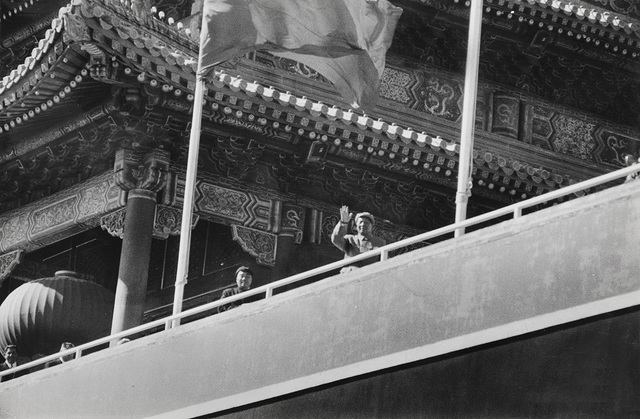
Photographs captured by artists from past to present in news may play significant roles in history, it may provide information for later generations needed for proof, or act as proof in modern day for audiences watching news reading history books for education purposes, touristic traits of countries, for example. The moment in which truth should be captured when photographing means it's down to the individual capturing, as theorised by Henri Cartier Bresson, 'The Decisive Moment.' This moment demonstrates the idea that you as the photographer can decide when the "spontaneous" moment is seized from a moving moment to still, this still image then becoming a story in itself. Bresson theorised this photographic rule through his practise of photography, after beginning surrealist photography then moving to documentary and news photojournalism in late 1930's. His documentation of the Queens Jubilee and cities such as Shanghai China in 1947 as shown below not only practise well thought composition allowing balance to the photo, but also document the time period using angles and decided moments not many may have been able to capture. His decided moment gives strength in story to the photographs, for example the photo on the left of a Chinese leader, where Bresson may have waited for him to stand in a specific place on the balance, then allowing symmetry between the two poles next to him. It also isolates him as a leader, giving us connotations about his leadership. His collections of surrealist and war photography can be used as examples of time periods where surrealism and art movements were increasingly popular, whilst also capturing the life of war with ability to analyse these based on Bresson's successful framing and composition. Having the decisive moment is as close to capturing the essence of time of an event.

Image result for henri cartier bresson china

Overall within photography, there has been a vast amount of journalism photographers who have documented societies around them, constructing history of issues that become progressively more important. Without photojournalism, information of previous events may never have reached human knowledge, which affects the social and political impact on the world. I feel that the medium has been a reasonable one to use for news and documentation in the past, and may continue to be into the future with the further development of new technology and a converging media.


Biblography - As followed under 'references' 


Wednesday, 19 February 2020

References

The decisive moment information in photography -
Bresson-Cartier, Henri (2003) The Man, The Image & The World: A Retrospective" London, Thames & Hudson.

Well known photojournalist - 
McCullin, Don
https://donmccullin.com/don-mccullin/


The history of photo editing - 
Photo Services (2019)
https://fixthephoto.com/blog/retouch-tips/history-of-photo-retouching.html

The first photograph, Nichephore Niepce, Camera Obscura and Louis Daguerre - 
Niepce Nicephore, Maison. (2019)
https://photo-museum.org/niepce-nicephore-daguerre-physautotype/

Nan Goldin 
Artnet Worldwide Corporation (2020)
http://www.artnet.com/artists/nan-goldin/

Nan Goldin, photojournalism of drugs and sex 
Abrams, Loney (2016)
https://www.artspace.com/magazine/art_101/close_look/how-nan-goldins-snapshots-of-sex-drugs-and-death-redefined-photography-54026

Late 19's fashion and photography trend
https://en.wikipedia.org/wiki/Heroin_chic


I-D magazine
I-D (2016)
https://youtu.be/uPJ6NT2RXk4

Female journalist photographers
Palumbo, Jacqui. Brienne, Walsh, (2019)
https://www.artsy.net/article/artsy-editorial-20-women-new-faces-photojournalism

Erica Canepa 
Canepa, Erica
https://www.ericacanepa.com/

Wednesday, 29 January 2020

Change of idea

Further continuing into the specialist study, I have come to the conclusion that the previous idea of photographers perspectives, etc, is not something I would like to continue into the Final Major Project as I would like to explore something with more worldly meaning and impact, therefore would make sense to change in linkage to something that links in more clarity, considering the research and referencing for this project could then be a foundation for the future contextual research, which will be undertaken within the FMP.

Initial notes/alterations to the idea in linkage to FMP -
- Photography documentation
- Photojournalism into feminism and LGBT.
- To what extent does photography capture the essence of time
- Past, present & future.
- Future, prism and Lensball photography. (possible research into artists who manipulate the frame using objects)

Change of idea -
I would like to explore the idea of photography documentation, considering how photography has reflected certain major events in the world and how the medium has documented a certain time period. These time periods may include WW2, 2nd/3rd wave feminism, political UK movements e.g Margaret Thatcher, trade propaganda with the U.K to overseas, migration, etc. How well the truth is shown through these photographs in a situation where the whole truth is needed is an interesting factor, whilst also playing with the concept of time. I plan to choose a significant time period to focus on for the final project and will currently explore how well photography captures time.

Tuesday, 28 January 2020

Art and truth

Types of truth -

Correspondent truth - 
Proposition matching upto what we know through human senses. Claiming something is true because we saw it, for example.
Coherence - 
Relating the truth to whats logical - fitting it with what we know to make sense. 
Consensus -
The majority of people believing something is true, therefore following this. 
Pragmatic - 
The truth is whatever we say it is - whatever suits or works for us. 

Is art true to reality?
Art is something that can take many forms, this includes painting and drawing itself,  photography, music, performing, etc. It can be seen as a way to express one's feelings, whether this be true to reality or not is the contradicting question. Some may feel that art is a distraction from reality, meaning that any art created has intentions behind it and tells various stories. Personally, I feel that art is true to reality, considering art is created by said artist, and this artist may have been inspired. Any inspiration has come from real-life situations as they are also human, therefore there is some actual reality involved in the creating process.

Is art a true likeness?
Considering you can be as abstract as desired within art, there is no right answer. People love being right, though if you cannot be right or wrong, it defeats the whole purpose, which could suggest that everyone is right, or none are wrong. This attribute, as well as others, is positive. It seems that there are a majority of positive connotations about art, others may include the fact that it is used as a good distraction from a society that is troubled and negative. The question is also arose - if art wasn't around, would things be the same and would it change people's moods?

Does art show the truth / is art artificial?
Art can or cannot show the truth, depending on the artist's intention. If one is trying to portray the truth, there may be visible symbols that reflect this and link to real-life political/social things. Though in demonstration of the DADA movement (in terms of drawing/painting art) it has been used as a distraction from reality, therefore going against the truth and creating a whole new world. In terms of being an artifice, art is something creative that is made by people with different skills and mindsets. It makes it artificial, it being something that is not solid truth, but is another way to reflect something truthfully, or even changing people's perspectives and convincing them to see the truth.

Pablo Picasso - "Art is the lie that reveals the truth"
Pablo Picasso was a Spanish painter who made a huge impact on the art world. I feel he quoted the following words to describe the effect that art can have as mentioned previously, by changing people's perspectives. Art is not something real itself, yet its abstract freedom and no rule agenda means it can portray the truth in any way.

How does truth exist in -

Politics - Do politicians tell the truth? 
We, as the public, have minimal knowledge and control over what happens behind closed doors, this being in British politics and worldly politics. Though a democracy, we do not fully know if the government or said prime minister/mayor is telling the whole truth. This being for our own good, or as part of future plans that the government has themselves, linking Pragmatic truth theorised by William James, being that the truth is what works best in situation.  Gathering information from news sites and knowing what is going on in parliament is something we have a right to in the U.K and something we receive  - whether we know what is true or not is not in our hands.

Social -
Truth, propaganda and fake news are increasingly popular subjects in the modern age, considering the use of the internet as a news source and social media has become the norm. We as the public do not always know what news to believe - for example, seeing a screenshot of an article from Instagram but having no solid truth, in comparison to watching television news on BBC. Organisations such as the BBC, ITV, Channel 4, etc. have proved to be reliable most of the time, however in other forms of media such as websites and online articles, we do not truly know and have to check attributes such as the date of publishing, images, and if the author is a real person. Word of mouth can also contribute to the telling of truth, if something is told incorrectly or gets passed down as a story, details can change and be twisted, therefore also manipulating the truth.

How does society measure the value of truth?
Mainstream society may follow whatever they see, and what the biggest news / stories in general are in a consensus manner. Whether they value their time on social media enough to prove everything they see is their decision, and analytically shows us whether they are passive or active as an audience member. Society may value the truth where it affects them, protesting for equal rights may be an example, ensuring what's being said is truthful and being distributed in a truthful way.

Technology - 
In linkage to social, there are developing social media sites as well as technologies to accompany. Film itself can also be seen as something that is evolving including technology, through the use of new cameras with higher resolutions and quality, to special effects editing and VFX, that require new editing software's. Animations and 3D stop motions to new iPhone's with more cameras and IOS software makes it difficult for the new generation to back away and is something that seems to continuously grow into the future. This links to the idea of editing in truth and having virtual worlds. The more editing is done and more other 3-6D worlds created, the more the truth in technology seems to expand. It can be said that technology is now creating its own truth.

Does technology preserve the truth or manipulate it?
Personally, I feel that technology manipulates the truth, but can be helpful in certain situations. Evolving on a huge scale means dramatic changes, creating effects and visual elements that are not true. This would be manipulation, however, technology in places such as science labs may have helped scientists and geographers using high tech, new software, and equipment to measure things such as volcanic activity, or side effects of new viruses and checking whether a patent is able to recover. if there's a cure, etc.

Truth in media -

Documentary journalism -
Documentary filmmaking may commonly be used to expose a story in moving image form, which can be done in an observational, participatory or expository way. Whichever the filmmaker feels is most appropriate for said subject, letting the audience in and exposing the truth to them. Journalistic documentation therefore may take the form of a documentary.


Print journalism - 
Involving more still images and photography, print journalism includes the editorial aspects of creating a magazine, newspaper, poster, book, etc. and how this is distributed / printed for the audience eye. In comparison to documentary journalism, print journalism can be seen as more truthfully manipulating, considering the many ways it can be done. For example, printing misleading headlines with false dates, and editing photographs on software's like Photoshop, removing certain blemishes from ones face, for example, or making something seem more vibrant than it is. A scandal like this is Fyre Festival, demonstrating the practise of false advertising.

Radio journalism -
Considering radio programmes are live, it may make it more difficult for false information and lying, however, one must also consider that it is the unknown for the audience - having less to see, no visual headline, photographs, etc. would make it difficult to judge whether the news or story is truthful.  All would be similar to other journalists who would gather research, conducting primary research, interviews, etc, with a different distribution. Listening to the radio as a news source may be most reliable for some.

Convergent journalism - 

Convergence in media is the crossover of two mediums, for example, a website and photography coming together to promote a business. This is in contribution to 'New Media,' beginning in web 2.0. Convergence journalism may be more truthful or reliable than others when thinking about journalism, considering there are more than one sources used, with more information distributed not only in one way.

Truth - Knife crime
Knife crime and other social issues and truth around this may depend mostly on word of mouth and who had seen what, linking to the correspondent truth. Reasoning's as to why authorities would question any witnesses, depending on if they'd seen/ heard anything that will help put together the truth of the event. With an increasing amount of knife crime, especially in London, manipulating the truth can cause huge social issues, and possible long term economic issues.

Truth - The environment 
Within my previous projects, I have explored the topic of environment, attempting to highlight issues such as climate change, global water/ food and energy consumption inequality, recycling, etc. In doing so, I have identified that there is an evident issue - one that most in society agree with (Extinction Rebellion, Green Party e.g) and that others may disagree with. Linking to types of truth, one may say the truth about the environment is Coherent, as glaciers melting and high rising sea temperatures are examples of evidence that would prove climatic damage.

Truth - Prejudice 
Personally, I feel that one cannot have an opinion unless they have undertaken the activity or said thing, therefore cannot judge whether something is true or not. Having an opinion not based on any experience and labelling something as true, therefore, may be hard to believe by others, considering there is no personal connection, therefore no primary / second nature information - then having to use secondary resources, linking to the theory of Consensus truth.

Monday, 27 January 2020

Contextual case study

Truth in the media can be perceived in many ways. Gatekeepers and leaders of media distribution have power over what the audience sees, therefore we can never fully be sure that what we see in technology, on social media or on the World Wide Web is true. As a content producer, I feel there are two responsibilities that contradict - ensuring what my audience sees is true in comparison to ensuring my media product does the best that it can, marketing-wise. This can play around with emotions such as guilt, also known in previous situations such as the story of The Girl and The Vulture, therefore possibly manipulating the truth.

As I have chosen to carry out photography for my final major project, I have been researching photographers who currently play around with the truth, with further ideas that I would like to explore on set camera manipulation, this including changing shutter speed, aperture, ISO and white balance/filters and how this affects the final image, in addition to what the photographers final decision is. A photographer who explores this is Michel Szulc Kryzyanowski, a dutch, experimental artist, who explores photography through sequences in distribution and on location when deciding when the 'decisive moment' is. A decisive moment, theorized by Henri Cartier Bresson, is the visual, exact moment people in the scene resonate well to portray that real-life moment in photography. This moment decided by the photographer can affect what the real truth is, e.g the photographer may frame the photograph so that it twists what is actually happening. This would be playing with composition. An example of Michel's photography is below, from a collection called "The Extraterrestrial Highway" The collection involves many photographs using landscape photography and interrupting subjects, a distraction from what the actual background is, manipulating truth using camera angles. These are all situations where he has let life flow around him - letting the sun get to a certain point of the day where it will reflect off these two landmarks and cause a shadow in this particular photograph below. This then affects the colour of the sand and tells us something about the time of day in a particular area. He let life around him continue - the sunlight, and framed the camera when ready, As quoted from the artist - "The location does not give the photographer any reason to take photos... the photographer himself... is fully responsible for the interesting, unique or exceptional events that should later arouse.... the public." In contribution to this particular photo, we can try to understand or analyze why Michel chose this time of day - did he plan to get this composition and height of shadow at all, breaking the rule of thirds but also framing so that the lampost is somewhat in between mountains - though if we saw it in a different angle, the lampost would be behind mountains on the other side, or a river, etc. In terms of truth, the difference of situation may have caused a different outcome, therefore manipulating what's true.
Technical attributes behind the photograph would involve the adjustment of aperture, ISO and white balance. It seems the photograph has been taken using the 'Cloudy' white balance setting, being 15,000k in lighting. On the subject of colour correcting, it seems that no editing has been done, possibly only in vibrancy and saturation settings. For the bright overall background image, the photographer may have had a high ISO - 800 and above, and a low aperture, 5.6 to 8, considering the small value in aperture means more light in the lens. All these attributes in contribution to the taking of the photograph question its authenticity, what if the background was slightly darker if the ISO was lower and the photographer was moving with a slower shutter speed creating a blurred effect - would the overall outcome be different, and would we as an audience see that the photograph may have in fact been taken at a later time in the day - due to a darker background, or a change in colour to the blue sky into sunset colours
http://www.szulc.info/nlmedia.html


As this is a photographic piece, the only truthful elements would include the onset camera settings, composition, and editing in Photoshop involving post-production. Other images the photographer has taken include the following below, in this case in "Mile 75" the photographer has purposefully framed or placed an object that practises the line of symmetry, whilst interrupting the whole back image. It makes it more interesting than what it may have been without the interruption, however, we can never truly know considering we cannot see the rest of the image. Focus also plays a role in this situation, in terms of truth, how do we know that there was nothing behind the big distraction. The angle at which the photograph was taken at also makes the object seem bigger. If taken straight on, the object may have looked smaller in size, with somewhat indication as to what it may be. The colour settings in this image and of the above seem to be the same as if the photographer was trying hard to capture the real-life lighting of both and play around with composition only. Adjusting the white balance to Cloudy on both images / on the collection, therefore, adds some truth and reasoning behind the photographer's intention, in contradiction. 
Other photographs in the collection are as follows. They all have similar links in terms of a blue hue and theme of letting still life run and waiting for that perfect moment. The photograph of the car titled "Mile 95" can be seen as contradicting the truth. The photographer has set the lower shutter speed to get the blur effect of the car, however, if seen that in real life, would we see the car as still - or moving so fast in a blur?
Waiting for the decisive moment also comes in "Mile 45" the composition of the clouds may have been different an hour before or after, changing the overall meaning of the photograph considering the artist may have changed position or camera angle if the clouds were not present. 
Lastly, as an example of the sequence where Szulc's mentality of "the location does not give the photographer any reason to take photos, everything has to come from the inside of the photographer" is practised in "Mile 20" The location does not seem the most vibrant however the people and other subjects on what looks like a construction site makes the photograph more interesting, and again play with the truth when considering what the photograph and location would look like if those subjects were not present. 


Wednesday, 22 January 2020

Focus group

As part of exploring my idea in more depth, I have spoken to fellow classmates and explained said the idea with given feedback. Some notes and quotations they provided are as follows, and I will consider all points when finalising my contextual case studies and progressing further into theory practice.

  • The idea of image manipulation seems to link well with truth, make it more clear that I am focusing on image manipulating when actually photographing, as it can be easily confused with post-production editing in Softwares like Adobe Lightroom and Photoshop.
  • Could explore experimental photographers, how they experiment with objects and many other elements -
  • What other elements of photography are there to explore in terms of photographing on set/location - yes, aperture, white balance, filters, etc... what else?
  • Could look at war photographers who manipulate the truth - therefore not only exploring the manipulation of truth visually but also contextually, politically, etc. 
  • Include the story about 'the vulture and the little girl' - I had explained this to my group members, in reflection that I should include it within my contextual research. 
  • In linkage to my Final Major Project, thinking about the concept behind what I plan to make - as I am planning to explore the technique of creating a photo montage - creating smaller images into one big image. 

Wednesday, 15 January 2020

Truth

Truth - A fact, thought or belief that is proven to be correct. 

Truth in the media - 
Internet - around since the late 1970s/ early 1980s. Used in universities to message and research, verifying beliefes.
Web 1.0 - The 1st version of the web, characterized by research and sending emails.
Web 2.0 - 2nd version of the web developed during the early 2000s. Characterized by live chats and instant messaging, including MSN, social media, Myspace, all forms of interactivity. The biggest video uploading site, Youtube, launched in 2005.

Key theorists -
- Henry Jenkins - Convergence in the media
- Shirky - Has explained the social and economic effects of the modern internet. 


My specialist study idea -
In terms of exploring creative media production in linkage to the truth, I would like to explore the idea of camera manipulation within photography - experimenting with white balance, ISO/Aperture and shutter speed along with filters, and how this all affects the photographs during the production, rather than in post-production editing. Manipulating an image, therefore, questions its authenticity linking to our theme of truth.                                       

Essay

How well has photojournalism constructed the truth over time? Photography is a form of art originating in the 18th century, intertwining l...